

The Ultimate Cat and Mouse Game
How AI Fights Off Sneaky Spammers

Imagine checking your email and finding thousands of messages offering you "FREE MONEY!!!", suspicious links, or weird weight-loss pills. It sounds exhausting, right? In the early days of the internet, people actually had to clear out this digital trash by hand.
Today, you rarely see spam because an invisible, lightning-fast digital security guard filters your inbox. That guard is a Machine Learning (ML) Classification Model.
Let's lift the curtain and see how engineers use AI to stop spam before you even know it exists—no scary math required!
What is a "Classification Model" Anyway?
Think of a Classification Model as a smart sorting machine. In Machine Learning, "classification" simply means taking a piece of data (like an email) and putting it into a category (a "class").
Because we only have two choices here—Spam (junk email) or Ham (legitimate, good email)—scientists call this a Binary Classification Problem.
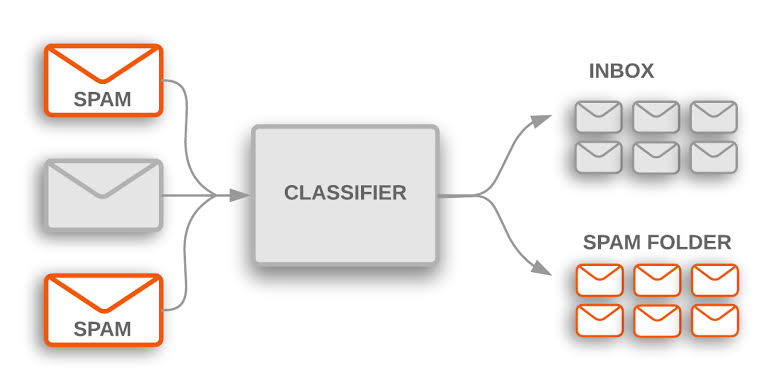
Instead of writing a million strict rules like "if an email contains 'winner', delete it," we teach the computer to learn what spam looks like on its own.
Teach, Don't Code: How the Model Learns
Humans learn by experience, and computers learn from Data. To train a spam filter, engineers feed the algorithm a massive dataset containing millions of pre-sorted emails.
Email Content | Real Category (Label) |
"Hey! Are we still meeting for project group study at 4 PM?" | Ham (Good) |
"CONGRATULATIONS!!! You won a $1,000 gift card! Click here NOW!!" | Spam (Junk) |
"Your monthly electricity bill is ready for download." | Ham (Good) |
"Urgent: Secure account access. Enter your password immediately." | Spam (Phishing) |
The computer studies these examples. It starts noticing patterns, like a detective looking for clues.
The Recipe: How an Email Gets Classified
An AI can't read an email like a book. It needs a structured workflow to turn words into decisions.
1.Text Preprocessing (The Cleanup):Step 1.
First, the model cleans the text. It removes punctuation, strips out useless words like "the", "is", and "and", and converts everything to lowercase. This helps the AI focus only on the words that actually matter.
2.Tokenization & Vectorization:Step 2.
Computers only understand numbers. Tokenization breaks sentences into individual words. Vectorization turns those words into a tally or mathematical score. The email effectively becomes a list of numbers representing word frequencies.
3.Feature Extraction:Step 3.
The AI looks for specific "clues" or features. It checks the sender's domain name, counts the number of ALL CAPS words, and flags suspicious links.
4.The Prediction:Step 4.
The algorithm processes these clues and outputs a probability score between 0 and 1. If the score is greater than 0.5, it confidently routes the message straight to the Spam folder.
Meet the Algorithms: The Brains Behind the Filter
Engineers use different types of algorithms depending on how complex the spam is. Here are three popular models described simply:
1. Naive Bayes (The Statistician)
This model calculates probabilities based on word frequencies. It asks: "What are the odds this email is spam given that it contains the word 'Crypto' three times?" It's fast, lightweight, and surprisingly accurate for basic filtering.
2. Support Vector Machines (The Border Patrol)
Imagine plotting your emails as dots on a graph based on their features. An SVM draws the widest possible line or boundary between the "Good Email" dots and the "Spam Email" dots. Anything landing on the wrong side of the line gets blocked.
3. Deep Learning / Transformers (The Advanced Reader)
Modern spam filters (like the ones Gmail or Outlook use) utilize Neural Networks. They don't just look at isolated words; they understand the context and tone of the sentence, effortlessly catching clever scammers who misspell words on purpose (like writing "V1@gra").
Why It's a Constant Game of Cat and Mouse
Spammers are sneaky. When they realized AI models auto-blocked the phrase "free money," they started writing things like "f.r.e.e m.o.n.e.y".
This is why Machine Learning is so crucial. Instead of software engineers manually rewriting code every time a hacker changes tactics, the ML model continuously retrains. Every time you click "Report Spam" in your inbox, you are personally acting as a teacher, feeding the model fresh data so it can get smarter for tomorrow.