
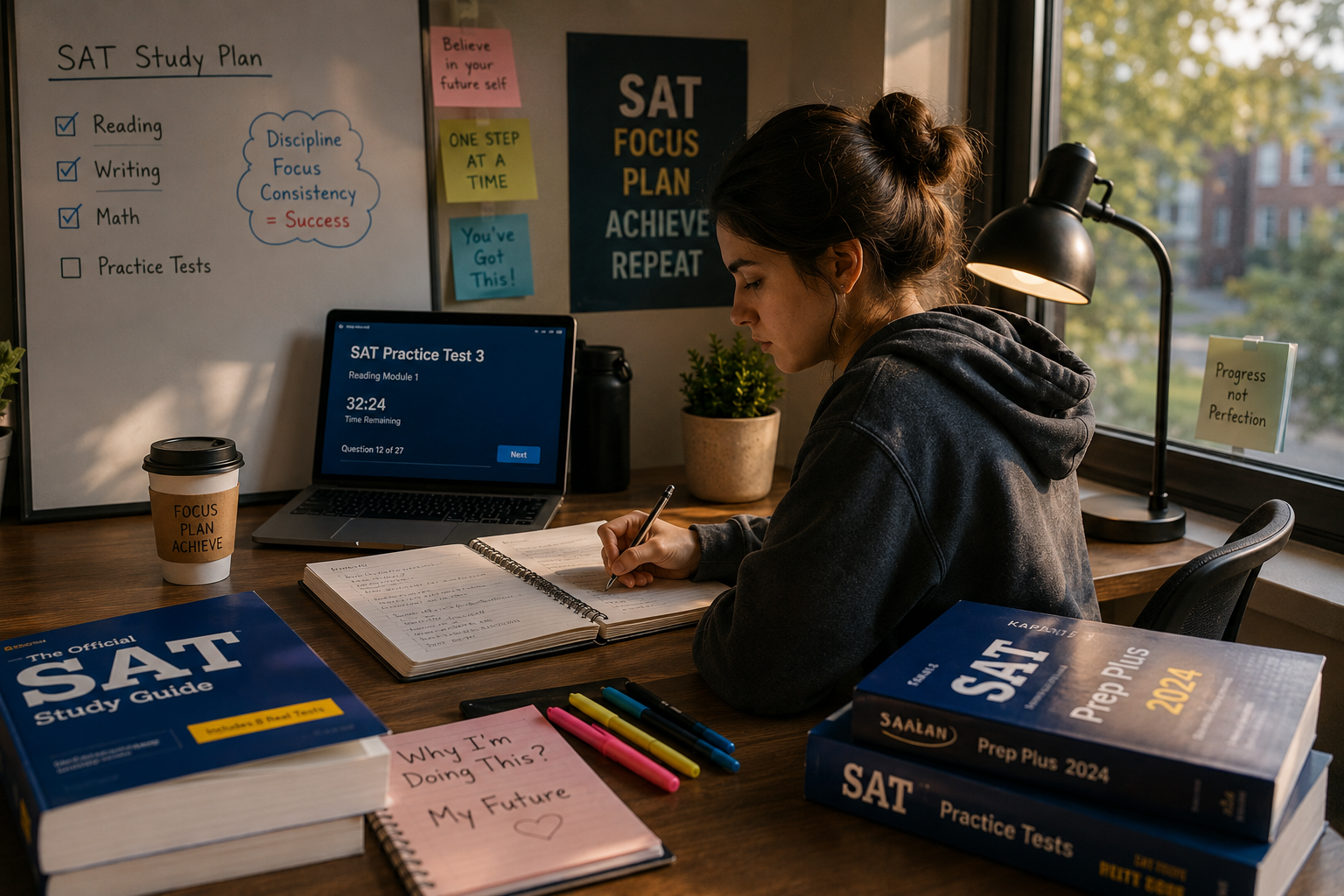
Demystifying the SAT
Your Ultimate Guide to Navigating the Digital Exam

If you are planning to apply to colleges in the United States, you've undoubtedly crossed paths with the letters S-A-T. While the college admissions landscape has evolved significantly over the last few years, the SAT (Scholastic Assessment Test) remains a powerful tool to make your application stand out.
However, if your older siblings or friends took the test a few years ago, forget everything they told you. The days of agonizing over 3-hour paper tests and massive reading booklets are gone. Today’s SAT is fully digital, adaptive, and highly streamlined.
Let's break down exactly what the SAT looks like, how it's structured, and how to conquer it.
The Big Picture: What is the SAT?
The SAT is a standardized entrance exam administered by the College Board. It is used by a majority of colleges and universities in the US to assess your readiness for college-level work. Even with many schools adopting test-optional policies, a strong SAT score can heavily tip the scales in your favor for admissions and merit-based scholarships.
Here is a quick snapshot of the modern exam format:
Feature | Details |
Testing Mode | Fully Digital (via the Bluebook app on your laptop or tablet) |
Total Duration | 2 Hours, 14 Minutes (plus a 10-minute break) |
Total Questions | 98 Questions |
Score Range | 400 – 1600 (200–800 per section) |
Penalty for Guessing | None. No negative marking! |
How Does "Adaptive Testing" Work?
The defining feature of the current SAT is multistage adaptive testing. The exam is split into two main sections: Reading & Writing, and Math. Each section contains two timed modules.
Module 1 (The Baseline): Everyone starts with a broad mix of easy, medium, and hard questions.
Module 2 (The Adaptation): The Bluebook app grades your first module in real-time. If you perform well, your second module will feature more challenging questions. If you struggle, your second module will be slightly easier.
Crucial Strategy Note: Because the test adapts, you must do well in Module 1 to unlock the higher-difficulty Module 2. A top score of 800 in a section is only mathematically possible if you qualify for the harder second module.
Section Breakdown
Let’s take a look under the hood of the two sections you will face on test day.
1. Reading & Writing (RW)
Structure: 54 Questions | 64 Minutes (split into two 32-minute modules)
The Format: Gone are the days of reading a 700-word historical essay and answering 10 questions about it. Now, you will see short passages (25 to 150 words) with exactly one question attached to each.
Because the passages are brief, every single word counts. The test creators love to drop subtle pivot words like "however" or "granted" to completely flip the meaning of a text. You will be tested on vocabulary in context, grammar conventions, and your ability to look at charts or graphs and pick the exact piece of evidence that proves a scientific or literary claim.
2. Mathematics
Structure: 44 Questions | 70 Minutes (split into two 35-minute modules)
The Format: Roughly 75% of the questions are classic multiple-choice, while 25% are Student-Produced Responses (grid-ins), where you calculate the answer and type it in manually.
The massive upgrade here? A calculator is permitted for the entire Math section. The Bluebook app actually has the powerful Desmos graphing calculator built right into the interface. The syllabus focuses heavily on Algebra, Advanced Math (like quadratics and functions), Problem-Solving/Data Analysis, and Geometry/Trigonometry.
3 Quick Tips to Kickstart Your Prep
Master Desmos Early: Having a graphing calculator available for every math question is a massive advantage—but only if you know how to use it efficiently. Don’t wait until test day to learn how to graph an equation to find its intersections.
Build Up Contextual Vocabulary: Rather than memorizing long lists of obscure dictionary words, focus on reading high-quality publications (like The New York Times, Scientific American, or The Economist). The SAT tests your ability to understand how common words behave in complex academic settings.
Practice in the App: Download the official Bluebook app from the College Board immediately. It contains full-length adaptive practice tests that perfectly replicate the real exam interface, complete with the built-screen timer, highlighter tools, and formula sheets